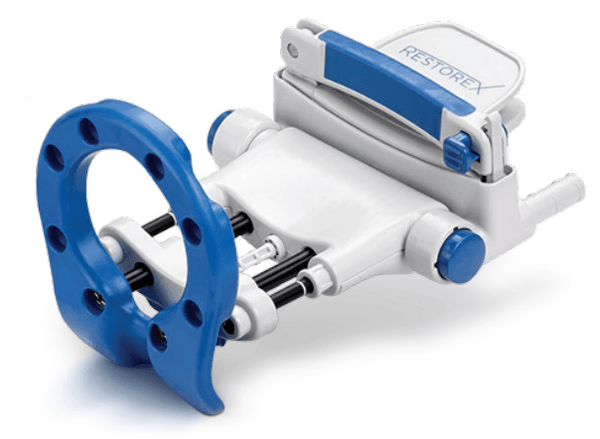
The RestoreX™ is patented, guaranteeing the exclusivity of its dual traction force technology. It is manufactured in the United States by PathRight Medical, located in Orem, Utah.

RestoreX™ was invented by Dr. Landon Trost, an American urologist specializing in Peyronie's disease and author of numerous studies and clinical guidelines regarding this condition. He has no professional or financial ties to PathRight Medical, and his clinical publications concerning Peyronie's disease or RestoreX™ have all been conducted according to the ethical and scientific procedures defined by the AUA (American Urological Association).
The axial traction force is between 2.5 and 3 kg, and the force on the counter-curvature is between 4.5 and 5 kg. The power of these traction forces is the primary reason for the effectiveness of RestoreX™ and is unmatched by other traction therapy devices. To prevent the penis from slipping during traction, the glans is clamped onto a very wide base, securely anchoring it and distributing the pressure over a large contact area to minimize pain.
RestoreX™ is effective in correcting penile curvature but also in treating hourglass-shaped penises.
RestoreX™ is the only treatment that has shown tangible results regarding penis length recovery 1b, 2b.
The RestoreX™ has CE marking, which classifies it as a genuine Medical Device.
Comparative table of penile traction devices
Sources: Websites and user manuals of various manufacturers
| RestoreX™ | AndroPenis | X4 | PeniMaster | |
|---|---|---|---|---|
| Duration of treatment | 30 to 60 minutes/day | 9 hours/day | 5 hours/day | 3 hours/day |
| Invention developed by a doctor specializing in Peyonie's disease | ||||
| Double pulling force | ||||
| Focusing traction on the deformation zone | ||||
| Prospective randomized clinical studies for Peyronie's disease | ||||
| Randomized clinical studies for post-prostatectomy penile lengthening | ||||
| FDA approval and CE marking | ||||
M.J. Ziegelmann & al. - 2019: Outcomes of a Novel Penile Traction Device in Men with Peyronie's Disease: A Randomized, Single-Blind, Controlled Trial
110 patients, mean age 58 years, Peyronie's disease history: 49 months, mean curvature 59.3 degrees.
Four groups: one control group (number = 27) and three RestoreX™ groups with daily usage sessions: group 1 (number = 28) → 30-minute session, group 2 (number = 28) → 60-minute session, group 3 (number = 27) → 90-minute session. RestoreX usage time is divided equally (50/50) between axial traction and counter-curvature.
A. Results at 3 months, average usage of 47 minutes/day
- A 17.2° reduction in curvature, or 28%, was observed in 77% of patients who responded to treatment (control group).
= +1.3°). Among these 77%, or about 4 out of 5 men, who observed a reduction in curvature, 28% of them achieved a reduction in curvature of 20° and for 48% of these 77%, the reduction in curvature was greater than 20°. - Penis length recovery : +1.6cm or +11% for 94% of patients who responded to treatment
(control group = +0.3cm). - Improvement in erectile function according to the IIEF score of 4.3 (control group = 0.7).
- 47% of patients could not have sexual intercourse with their partner due to insufficient penile tumescence: at the end of the 12 weeks of treatment, 80% of these reported being able to penetrate their partner.
- No adverse effects were observed (bruises, petechiae, etc.)
- 100% of patients who had previously tried another traction therapy device reported preferring RestoreX™.
B. 2 additional phases of the clinical study at 6 (n=64) and 9 (n=63) months of follow-up, daily use
average of 31 minutes/day
- 63% of patients reported improvements in curvature and length (+0.5 cm).
- The score on the International Index of Erectile Function (IIEF) questionnaire was also increased.
- 84% of patients continued to use RestoreX™ after 9 months.
The average curvature observed in this study was 59.3°, which classifies this value as almost severe (> 60°). The average curvature, reported by clinical studies, is generally between 30° And 50°.
The average duration of Peyronie's disease is 49 months This implies an exponential hardening over time of the fibrotic plaque as well as an increasing retraction of the tunica albuginea.
These two very demanding criteria represent a real challenge for RestoreX™.
23% Some patients did not experience any improvement. We tried to understand why these patients were not responding, and the explanations varied: some were not using the device correctly, others were not using it at all, and still others were probably doing everything right but were not getting a response. We do not know why this last group did not respond.
The reduction in curvature at 3 months is 17.2°, either 28% This represents a considerable improvement. Degrees are an absolute way to measure angulation, while percentage is a relative value that varies according to the degree of curvature.
For example, if a person has a curvature of 100° which will be reduced by 40° With RestoreX™, she will notice an improvement in 60° and also 60%. But, if another person whose curvature is 40° records, as in the clinical study, an improvement in 20°, she will recognize an improvement in 50% compared to the original curvature.
Consult our clinical studies and their summaries to verify the effectiveness of RestoreX™
Study No. 1A | Study No. 2A | Study No. 3A | Study No. 4A | Study No. 5A | Study No. 6A |
M.J. Ziegelmann & al. : Outcomes of a Novel Penile Traction Device in Men with Peyronie's Disease: A Randomized, Single-Blind, Controlled Trial /AUA - The Journal of Urology – September 2019, Volume 202, Page: 599-610
Prospective, randomized clinical trial of traction therapy
penile with RestoreX™ in men with Peyronie's disease: initial phase results (3 months).
J. Joseph & al. : Outcomes of RestoreX™ Penile Traction Therapy in Men with Peyronie's Disease: Results from Open Label and Follow-up Phases / The Journal of Sexual Medicine – 2020; 17:2462-2471
Prospective and randomized clinical study of penile traction therapy with RestoreX™ in men with Peyronie's disease: results of the follow-up phase (6 and 9 months) after the initial phase (3 months).
K. Wymer & al. : Comparative Cost-effectiveness of Surgery, Collagenase Clostridium Histolyticum, and Penile Traction Therapy in Men with Peyronie's Disease in an Era of Effective Clinical Treatment /The Journal of Sexual Medicine - 2019;16:1421e1432
Cost-effectiveness comparison in the United States of 3 therapies for Peyronie's disease : RestoreX (traction therapy) vs Clostridium Histolyticum Collagenase vs Surgery.
M.J. Ziegelmann & al. : Clinical Experience with Penile Traction Therapy Among Men Undergoing Collagenase Clostridium histolyticum for Peyronie's Disease /AUA - The Journal of Urology – January 2017104: 108
Evaluation of the treatment of Peyronie's disease with Clostridium Histolyticum Collagenase (CCH) combined with a traction therapy device (Andropenis™).
Mr. Alom & al. : Efficacy of Combined Collagenase Clostridium histolyticum and RestoreX™ Penile Traction Therapy in Men with Peyronie's Disease /Tea Journal of Sexual Medicine - 2019;16:891e900
Evaluation of the safety and efficacy of RestoreX™ combined with Clostridium Histolyticum Collagenase (CCH) compared to CCH alone and to CCH combined with other traction therapy devices (AndroPenis™, X4 Labs Penis Extender™ and PeniMaster™).
B. Green & al.: Comparison of Collagenase Clostridium histolyticum to Surgery for the Management of Peyronie's Disease: A Randomized Trial The Journal of Urology 210(5):p 791-802, November 2023.
A prospective, randomized clinical trial comparing Peyronie's disease therapy between group 1: Clostridium Histolyticum Collagenase + RestoreX™ + Sildenafil (CCH group) versus another therapy Surgery + RestoreX™ + Sildenafil (surgical group).


The RestoreX™ is marketed by Med'Arte, a French company specializing in the sale of medical devices for Urology to healthcare facilities.
-
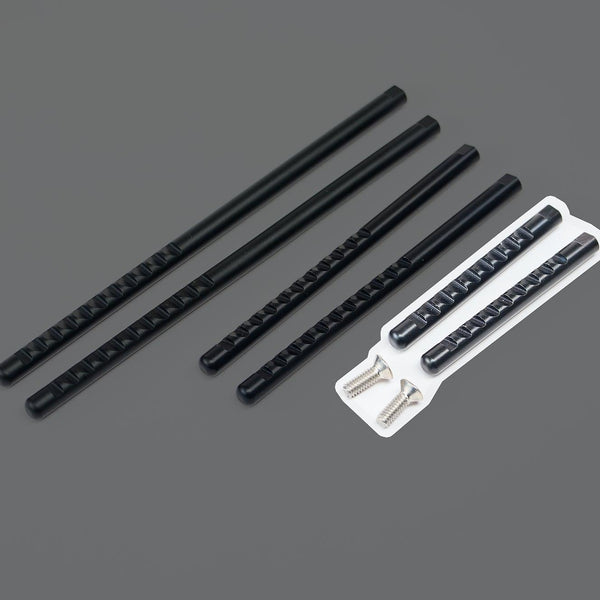


2 extension rods only
48,00€
-

Pelvic ring
36,00€
-

Lower clamp
48,00€
-

Upper clamp
60,00€
-

SHIPPING COST
8,84€